Most vintage Rolex watches are remembered for a clear purpose. The Submariner became inseparable from diving, the GMT Master from travel, and the Datejust from the idea of a practical everyday watch. The reference 6062 belongs to a very different period in Rolex history. It combined automatic winding, a complete calendar and a moon phase inside an Oyster case at a time when complicated Rolex watches were still unusual. That alone makes it interesting, but the real appeal of the 6062 goes much further than the list of functions printed on a specification sheet.
The stainless steel example now appearing at Monaco Legend Auctions is a good illustration of why collectors continue to pay such close attention to this reference. After roughly eight decades, much of the fascination lies not in how new the watch looks, but in how much of its original character has survived. On a vintage watch of this age, perfectly polished surfaces are not necessarily desirable. A strong case, an honest dial and surviving period details can tell a far more convincing story than a watch that has been restored until much of its history has disappeared.
That distinction also matters to readers who arrive at Ibis Watches through replica watches in the UK. The 6062 is a useful example of how little a simple list of dimensions can tell us about a watch. Copying the basic case shape or reproducing a moon phase display is only the beginning. The identity of a rare vintage Rolex is found in the relationship between its dial proportions, case finishing, engravings, hands and the way all of those elements have aged together.
Why the Rolex 6062 Still Feels Unusual
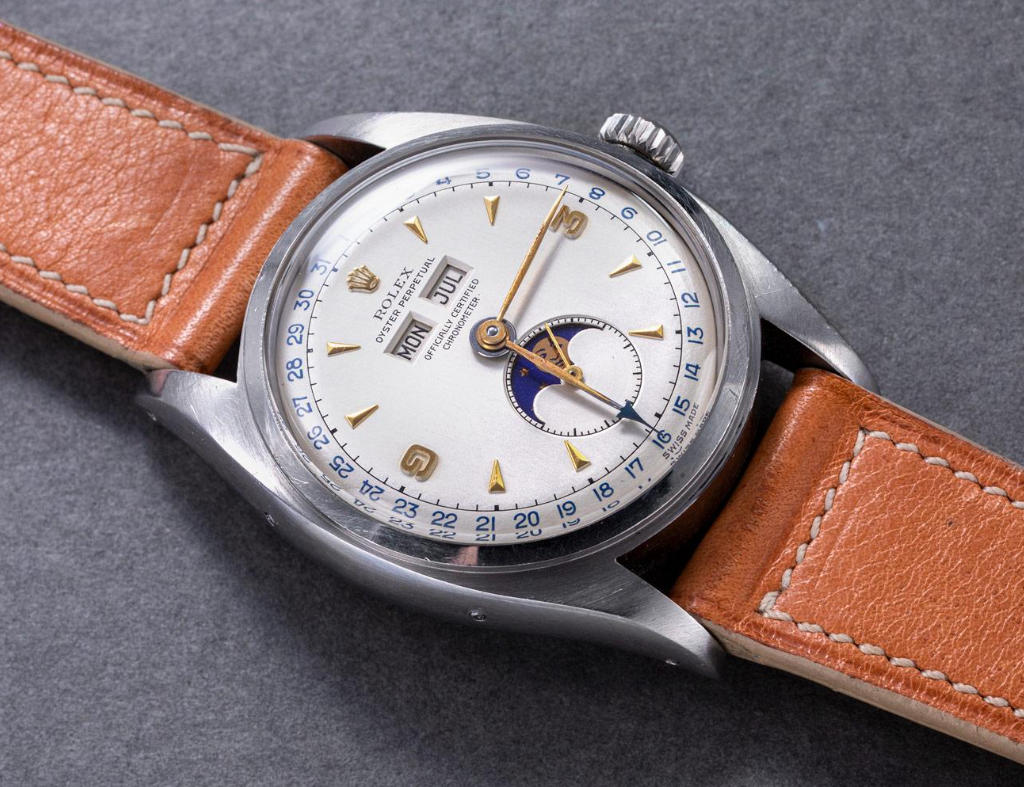
The ref. 6062 appeared around the beginning of the 1950s and remained in production for only a relatively short period. Its dial combines several indications without becoming visually chaotic. Day and month sit in two apertures beneath 12 o’clock, while a central hand points to the date around the outer edge of the dial. At 6 o’clock, the small seconds display shares its space with the moon phase. Today that arrangement may seem familiar to collectors of complicated watches, but within Rolex it represented an unusually ambitious approach.
Rolex also produced the ref. 8171 around the same period, another triple calendar moon phase watch, yet the two references have very different personalities. The 8171 used a more conventional case construction with a snap-on back. The 6062 placed its complication inside an Oyster case with a screw-down back. That difference is important because it connects the watch to the case architecture that would later become central to Rolex’s identity.
The 6062 therefore occupies an unusual position. It has the mechanical interest of a complicated dress watch but the practical case construction associated with the Oyster family. It does not look like the sports Rolex watches that later became famous, yet it already contains the design logic that would help define the company for decades.
Stainless steel examples make the story even more interesting. The reference was also produced in precious metals, but steel versions appear in very small numbers. Estimates of original production remain low, and surviving examples with convincing originality are scarcer still. That is why original condition on a stainless steel Rolex 6062 matters so much. Rarity attracts attention, but rarity combined with preservation is what separates an important vintage watch from a merely uncommon one.
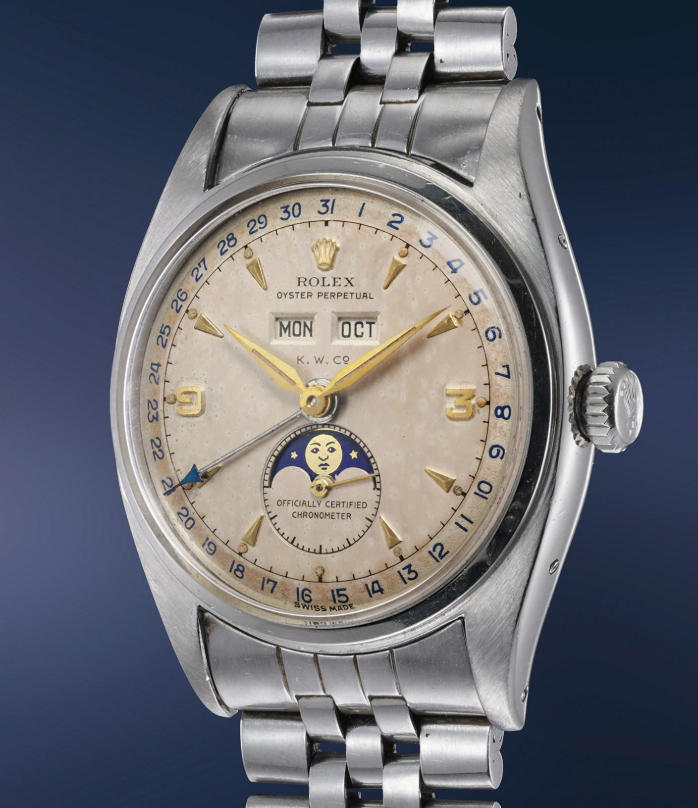
The dial on this particular example deserves careful attention. Its Arabic numerals at 3 and 9 give it the so called Explorer style appearance, while pointed markers occupy the remaining positions. Compared with more decorative gold references, the steel watch has a slightly more restrained character. The complication is still obvious, but the overall presentation feels less formal.
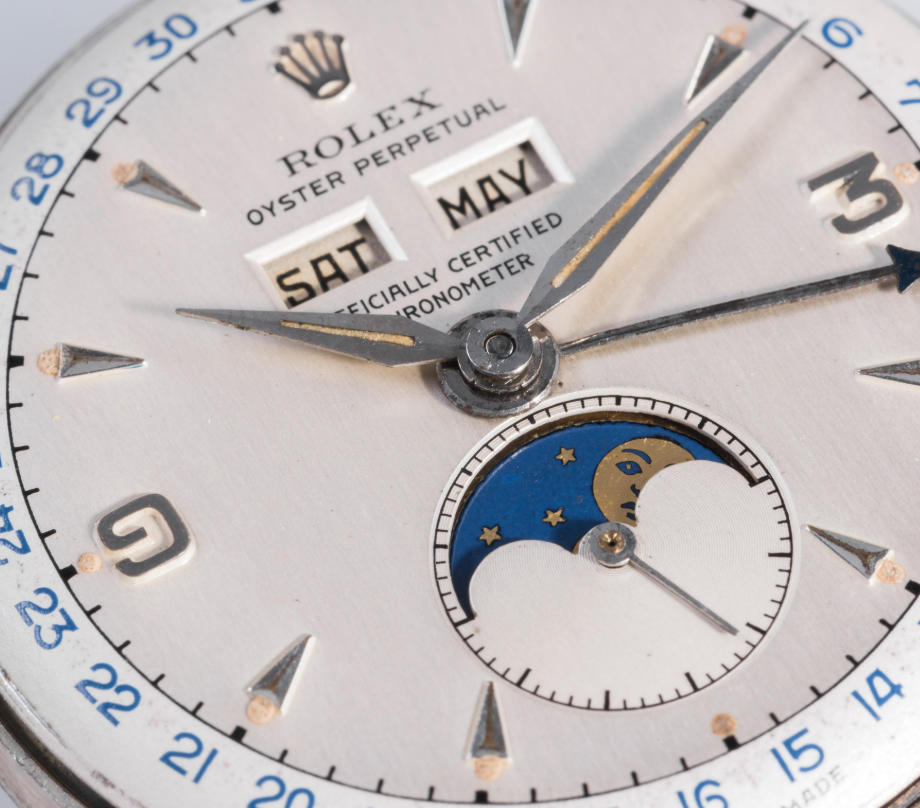
What makes the dial especially interesting is the way its different surfaces have aged. The central section and the outer date track were finished differently, and time has allowed those areas to develop separate tones. The contrast is not a flaw that needs to be corrected. In many ways it is the opposite. It helps reveal how the dial was originally made.
This is why Rolex 6062 two tone dial details deserve more attention than a simple description of colour. A genuinely old dial should not automatically appear perfectly even. Different coatings, luminous materials and surface finishes can change at different rates. When those changes make sense together, they can add credibility to a watch rather than reduce it.
The luminous material tells another part of the story. Period steel examples could use radium on the hands and hour markers, and over many decades that material can leave visible changes around the areas where it was applied. These marks may not always be beautiful in the conventional sense, but vintage collecting is rarely about achieving cosmetic perfection. It is often about deciding whether the signs of age belong naturally to the watch.
The case requires the same kind of judgement. Stainless steel may be harder than gold, but repeated polishing can still soften lug edges, reduce bezel definition and remove the contrast between brushed and polished surfaces. A watch that has survived for decades should not necessarily look untouched, but it should still retain enough of its original geometry to show how the case was meant to appear.
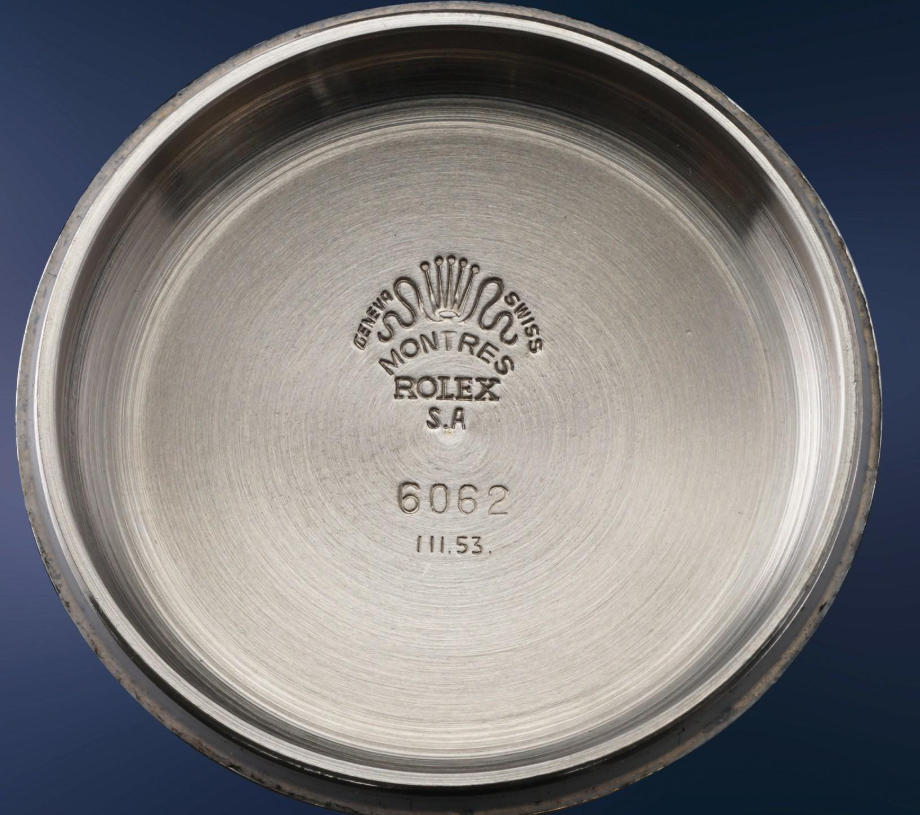
The caseback engraving is particularly useful in this respect because it is shallow. Repeated refinishing can weaken it quickly. The survival of the original Rolex 6062 caseback engraving can therefore reveal more about the life of the case than a freshly polished surface ever could.
The gold coloured hands and hour markers add another subtle point of interest. Against the stainless steel case they create a warmer appearance than some collectors may expect. Not everyone will prefer that contrast, but this is one of the pleasures of older watches. Collectability is not always the same thing as uniformity, and individual examples can develop personalities that do not fit neatly into modern expectations.
What the 6062 Reveals About Replica Accuracy
The 6062 is also a useful watch for understanding why replica accuracy cannot be reduced to one measurement or one headline feature. Reproducing the general dial layout is possible. Reproducing the balance of the original is much harder.
The day and month apertures have to sit at the correct height. The moon phase display needs the right diameter and position. The outer date track must occupy the correct amount of space, and the central date hand has to reach it naturally without making the dial feel crowded. These are small decisions individually, but together they determine whether the watch looks balanced.
This is why accurate Rolex triple calendar dial proportions matter more than simply having the correct functions. A replica can include a day display, a month display and a moon phase and still look noticeably wrong if the spacing between those elements is slightly off.
Age introduces another difficulty. Genuine patina does not develop evenly or predictably. Dial surfaces, luminous material, hands and case metal all change in different ways. Artificial ageing can imitate a colour, but it is much harder to recreate the relationship between several materials that have spent decades changing together.
The case creates a similar challenge. On an original vintage watch, sharp edges and surviving engraving matter because they show what has not been removed. On a replica, those same features are deliberately manufactured to resemble something that has survived. The visual result may be close, but the meaning behind the detail is completely different.
Readers comparing older designs through the Rolex replica watches section will usually learn more from studying these relationships than from relying on broad expressions such as perfect copy or identical to the original. Those phrases tell us very little about dial balance, case shape or movement construction.
The movement underneath the 6062 makes that distinction even clearer. The original watch combines automatic winding with a complete calendar and moon phase display. That is mechanically very different from the simpler movements commonly found inside replica watches. A watch can therefore look convincing from the front while operating in a very different way underneath.
For that reason, Rolex 6062 calendar and moon phase construction should be considered separately from visual resemblance. The importance of the original is not simply that several indications appear on the dial. It is that Rolex managed to bring those functions together inside an Oyster case at a relatively early point in the company’s history.
The auction estimate attached to this steel 6062 will inevitably attract attention, but price is not the most interesting part of the watch. Auction estimates change. Collector sentiment changes. What is much harder to replace is an example that has kept enough of its dial, case and small period details intact for us to understand what the watch was originally meant to be.
That is ultimately why the ref. 6062 remains such an important vintage Rolex. It does not depend on one dramatic design feature. Its character comes from the combination of an unusual complication, restrained Oyster proportions and the survival of details that become increasingly difficult to find as the decades pass.
For collectors, the lesson is that condition can matter just as much as rarity. For replica watch readers, the lesson is slightly different. Accuracy is rarely about copying one obvious feature. The convincing details are usually found in proportion, finishing and the way several small elements work together. On a watch as subtle and complicated as the Rolex 6062, those quiet details are exactly what make the original so difficult to imitate convincingly.
About the Author