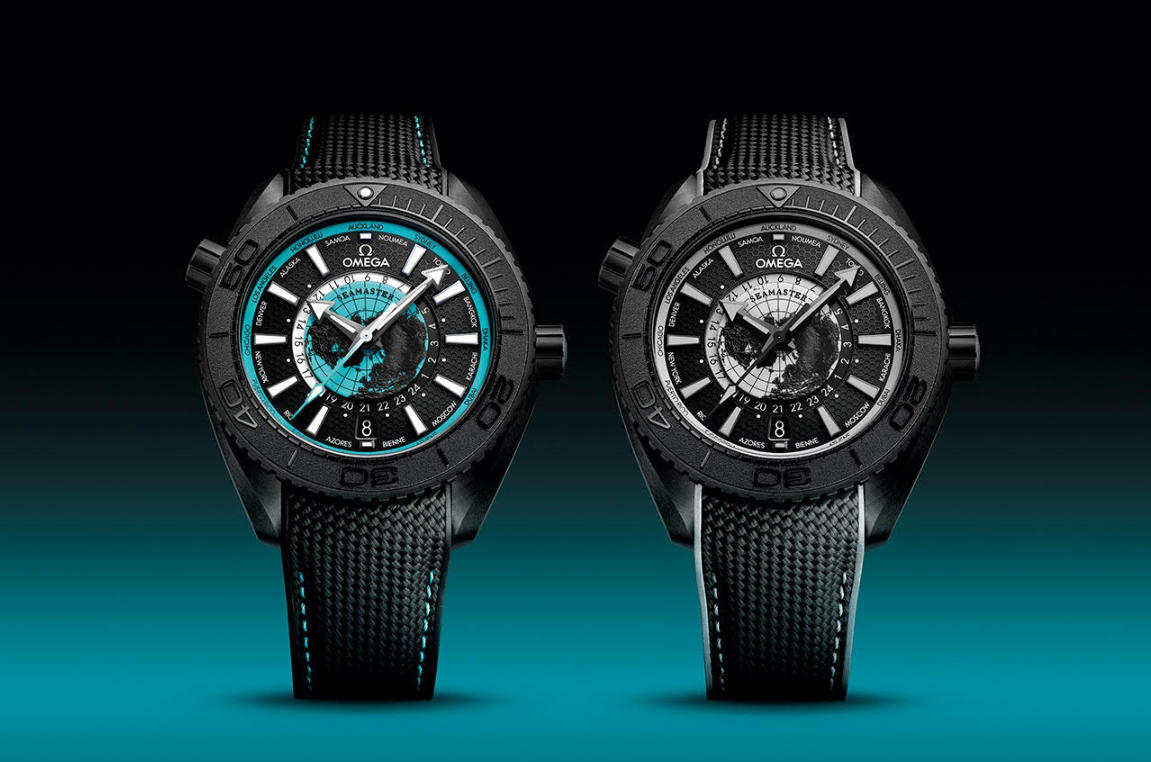
There is something slightly contradictory about the Omega Seamaster Planet Ocean Worldtimer, and that is exactly what makes it interesting. A world-time complication normally brings to mind airports, hotel lounges and frequent travel. The Planet Ocean, on the other hand, has always been one of Omega’s more serious dive watches. Putting those two personalities together could easily have produced a watch that felt confused. Instead, it has created one of the more unusual modern Seamasters.The Worldtimer itself is not new to Omega. The complication was already familiar from the Aqua Terra family, but moving it into the Planet Ocean changes the character completely. Here it sits inside a substantial black ceramic case with genuine dive-watch specifications rather than a relatively restrained everyday watch.
A Worldtimer That Still Looks Like a Planet Ocean
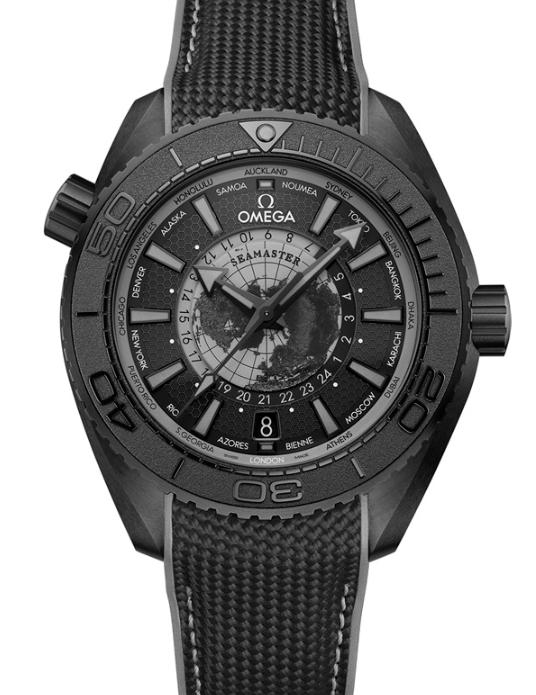
The first thing to understand is that Omega has not softened the Planet Ocean simply to make room for the complication. The case measures 45.5mm and is made from brushed black ceramic, while the matching ceramic bezel carries a laser-ablated diving scale. Water resistance remains an imposing 600 metres.That tells you quite a lot about the watch before getting anywhere near the dial. This is not intended to disappear underneath a shirt cuff. It is broad, technical and visually heavy, very much in keeping with the Deep Black side of the Planet Ocean family.For anyone studying replica watches in the UK, the case is one of the first areas worth paying attention to. On a watch like this, the finish of a black ceramic Omega-style case matters just as much as the basic dimensions. The genuine watch mixes large proportions with controlled brushing rather than relying on a uniformly glossy surface.
The World Map Is More Than Decoration
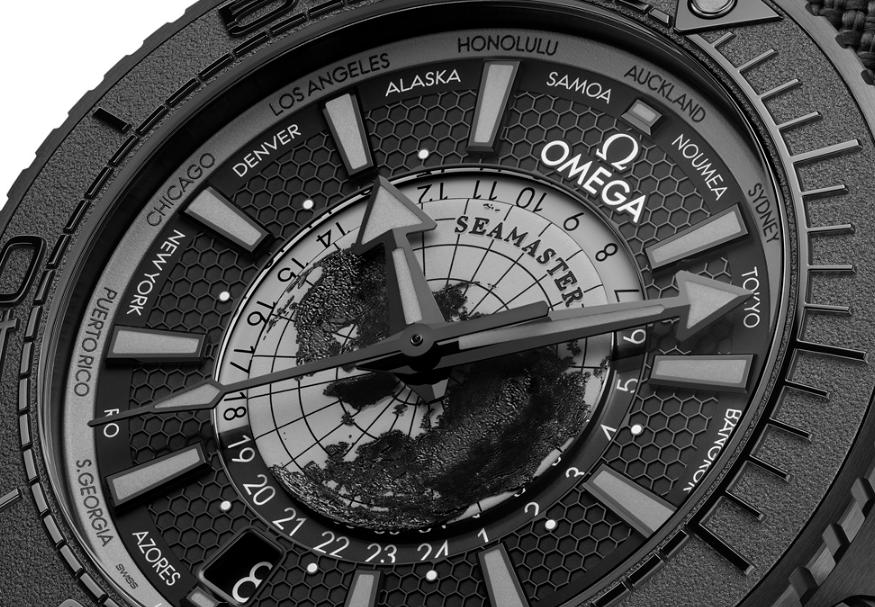
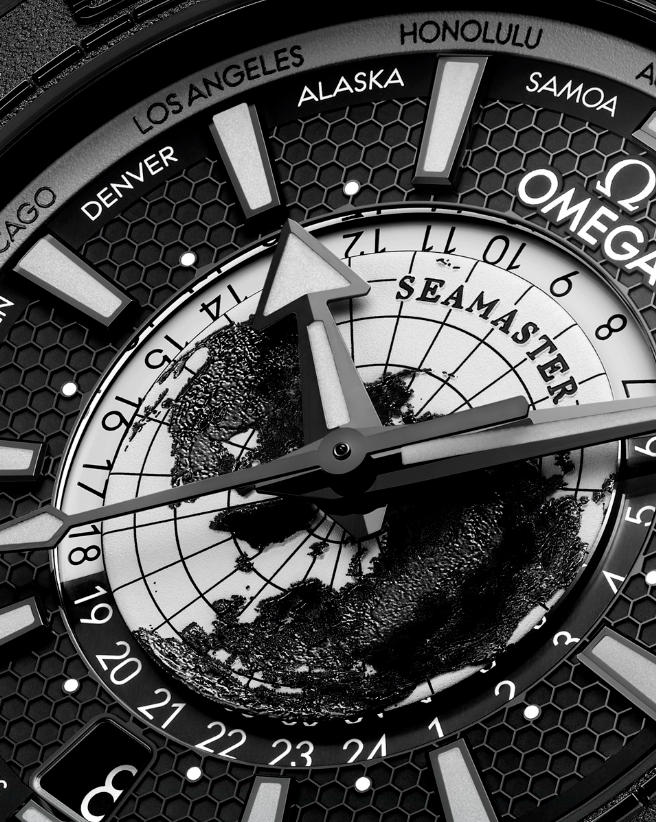
The centre of the dial is where the Planet Ocean Worldtimer becomes much more distinctive. Omega produces the map on a grade 5 titanium surface, showing the continents as viewed from above the North Pole. Laser ablation and varnish are used to create the topography.A 24-hour display surrounds the map, splitting the day into light and dark periods. Outside that sits the city ring used to read different time zones around the world. Omega even includes Bienne, its home city in Switzerland.There is a lot happening on this dial, yet it does not read like a traditional dressy world timer. The darker base, broad hands and dive-watch case keep the Planet Ocean identity intact.That detail is particularly relevant when comparing Omega Seamaster Planet Ocean Worldtimer dial details. A convincing interpretation is not simply a matter of printing a small map in the centre. The depth of the map, the position of the 24-hour ring, city typography and the relationship between all three layers determine whether the dial looks convincing or flat.
Turquoise or Grey Changes the Personality More Than You Might Expect
Omega offers two versions, and although the watches are technically very similar, they do not feel identical.The turquoise version uses brighter accents and white Super-LumiNova. The colour runs through the dial details and stitching on the black rubber strap, giving the watch a much more obvious contemporary character.The grey version is quieter. Its grey accents and matching luminous treatment work with the ceramic case rather than fighting against it. On the wrist, this is likely to be the easier version for someone who likes the technical nature of the Planet Ocean but does not necessarily want the colour to dominate.Neither is exactly subtle, of course. At 45.5mm, subtlety was never really the point.
Calibre 8938 Makes the Complication Useful Rather Than Decorative
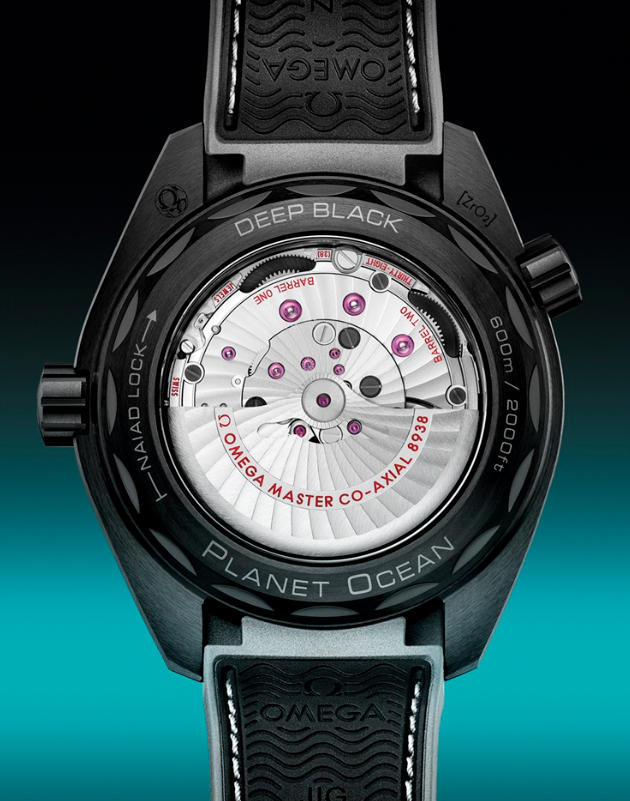
Behind the dial is Omega’s automatic Co-Axial Master Chronometer Calibre 8938. It can be viewed through the sapphire caseback and provides the world-time display together with an independently adjustable time-zone function.The movement carries Master Chronometer certification and offers approximately 60 hours of power reserve. It is also designed to withstand magnetic fields up to 15,000 gauss.Those specifications matter because the Planet Ocean Worldtimer would feel rather hollow if the travel function were merely there for visual effect. Instead, Omega has paired the complication with a movement that makes changing local time relatively practical when travelling.At the same time, the watch retains a rotating dive bezel, helium escape valve and 600m water resistance. It therefore remains a genuine Planet Ocean rather than an Aqua Terra Worldtimer dressed in a larger case.
Is 45.5mm Simply Too Large?
This is probably the most important question for anyone considering the watch.A 45.5mm diameter sounds large because it is large. The thickness and broad ceramic construction also mean this is not going to wear like a conventional 41mm steel sports watch.That does not automatically make the dimensions a flaw. The busy world-time display benefits from physical space, and Planet Ocean has never been a collection built around delicacy. The size makes considerably more sense when the watch is treated as a purposeful sports piece rather than an all-purpose daily watch.Still, buyers with smaller wrists should pay far more attention to real wrist presence than to photographs taken straight on. How a 45.5mm Planet Ocean Worldtimer wears on the wrist is arguably more useful information than the diameter alone.
Why the Seamaster Connection Matters
The Planet Ocean sits inside a very broad Seamaster family, and that can sometimes make the name confusing. A Diver 300M, Aqua Terra and Planet Ocean all carry Seamaster branding but approach the idea of a sports watch very differently.The Worldtimer makes that distinction even clearer. It borrows a complication associated with the Aqua Terra while retaining the case architecture and serious water resistance expected from the Planet Ocean.Readers comparing this watch with other versions can browse the Omega Seamaster watches section to see how different interpretations of the Seamaster idea sit alongside one another.
What Replica Watch Buyers Should Look At First
A model this detailed is not one where a convincing appearance comes down to a single specification. The obvious elements are the black ceramic case and central world map, but several smaller details deserve closer attention.
- The proportions and texture of the ceramic case
- The relief and spacing of the bezel markings
- The sharpness of the central world map
- The position of the city names around the dial
- The separation between the map and 24-hour display
- The colour and brightness of the luminous material
- The fit of the integrated rubber strap against the case
These details are more useful than broad claims about a watch being “perfect” or “1:1”. With a complicated dial like this, small inaccuracies tend to become visible quite quickly.
A Strange Combination That Actually Makes Sense
The Omega Seamaster Planet Ocean Worldtimer is not the obvious answer to a simple question. If someone only wants a travel watch, there are smaller and more discreet choices. If someone only wants a dive watch, the Planet Ocean range already offers simpler alternatives.What makes this model appealing is that it refuses to choose between the two ideas. It gives the wearer a proper world-time display while maintaining the oversized ceramic construction and serious water resistance associated with the Planet Ocean.That combination will not suit everyone, and at this size it was never going to. But for collectors who already like Omega’s larger sports watches, the Worldtimer gives the Planet Ocean a personality that feels genuinely different rather than simply changing a dial colour or case material.For replica-watch readers, it is also a useful reference point because the design leaves very little room for shortcuts. The case finishing, layered dial, map, city ring, lume and strap all have to work together. That makes the Planet Ocean Worldtimer an especially interesting watch to examine closely rather than judge from a specification sheet alone.
About the Author